

Pest Control for Bedbugs
Home / Pest Control Bedbugs
Pest Control Bedbugs
Expert Affordable Bedbug Control in Glasgow.
Warning!- some pictures may be slightly off-putting to some viewers!
Bedbugs (Cimex Lectularius) are one of the hardest to eradicate insects in Glasgow. They are small, oval shaped & usually mahogany brown insects which feed on human blood usually when the host is sleeping.
These are 2 pictures of bedbugs I killed in a 4 star hotel in the west end of Glasgow.
A fully fed bedbug (notice its size in relation to the screw in the picture)
A close up of a bedbug.
These bedbugs were also resistant to insecticide treatment (which previous contractors failed to pick up on). Within 3 treatments using our advanced treatment program these bugs were totally eradicated and the hotel has since remained clear of bedbugs.
Bedbugs can survive more than a year without feeding and are often resistant to lots of different insecticides. This can make bedbug treatments costly as great time, care and effort is required to carry out bedbug treatment.
If you are looking for a local bed bug exterminator in glasgow, lanarkshire, renfreshire, east renfreshire and all over central scotland who will fix your problem without killing you as well with charges then I am your guy! I do god knows how many flats, hostels, homes & hotels regularly. My success rate is extremely high. I can offer advanced insecticide chemical treatment as well as heat treatment of furniture or even whole rooms (depending on the situation we’re dealing with).
Here’s a picture of what a bedbug infestation can look like after only a few months in a flat in Govanhill (a notorious area for bedbug infestations:
Believe it or not there’s actually somewhere between 50-100 bedbugs in this picture you just can’t tell because some bed bugs are so small and light coloured that you see what looks like a dozen or so bedbugs when its really much higher.
An important point to note is that bedbugs can lay up to 3-7 eggs a day and they glue these eggs in cracks and crevices where the eggs are very difficult to find. This is truly an insect which is designed by evolution to survive regardless of our hygiene levels and living arrangements. Fortunately our technology and biological know how is catching up to these creatures and 100% eradication is becoming possible even in the heaviest infestations.
The main thing with regards to bedbug treatments in clients minds is understandably cost. As a local company we do not have the overheads of larger national companies so we can usually beat them hands down on cost. However if the focus is only on cost then quite often quality goes out of the window as the lower you go down on cost the more watered down the treatment becomes and believe me you do not want to battle bedbugs in your home with watered down treatments.
Our advanced treatments for bedbugs include the use of sophisticated monitoring and treatment equipment, the best in anti bedbug control insecticides and thorough treatments.
A common problem with bedbug treatments is that they can commonly be found in sofas, bed frames and mattresses. These items can be extremely difficult to treat and sometimes you may even have to replace them -a costly undertaking.
We are probably the only local company (not a national) in Glasgow who have access to advanced heat treatment technology which allows us to cook your bedbugs in your furniture meaning you don’t have to dispose of anything. Our prices are also again probably the cheapest in Glasgow for this sort of work.
For more information about bedbugs check out our bedbugs FAQ below or call us on 0141 846 0022.
We don’t offer a one size fits all price. This helps keep the cost down for the majority of our customers.
If you would like more information or prices then please call on 0141 846 0022.
FAQ’s BedBug Control Glasgow
We get a lot of questions regarding bedbugs in Glasgow. I thought I would answer some of the most common questions regarding bedbugs, their behaviour and control.
What are bedbugs?
Bedbugs, also known as cimex lectularius, are small oval shaped mahogany brown insects which feed off human beings by piercing the human skin and extracting blood for nourishment. They typically do this at night when the host is asleep. They are attracted to various different environmental cues such as body heat, CO2 (released when we breathe) and pheromones (chemical signals the body gives off).
In the laboratory bedbugs have been seen to survive more than a year without a blood meal. So even if the host stops entering a room where he/she believes there are bedbugs they may still be alive for up to and beyond a year. They are also resistant to various different insecticides commonly used in bedbug pest control making treatment more challenging.
Lifecycle?
Bedbugs start of as eggs which hatch into nymphs which are essentially miniature versions of adult bedbugs. A fertilised female bedbugs can the lay 3-7 eggs a day and glue these eggs into cracks and crevices in and around furniture and within buildings. Each egg will hatch at a certain temperature and a nymph bedbug will appear. Think of a nymph as a baby bedbug. The nymphs are essentially minaiture versions of the adults, creamy white and/or translucent in colour and hence difficult to see. They are not invisible. You can see them with the naked eye but it takes some detailed examination to catch one.
A female in her lifetime can lay somewhere between 200-500 of these eggs.
This nymph goes through what are called 5 instar stages where it grows to a certain size, sheds its skin ( a process called ecdysis) and form a new skin.
The end stage results in an adult bedbug. The adult bedbug unfed is a lot larger and a more mahogany brown colour or light brown colour. It is usually quite flat and oval shaped. When fully fed it is no longer flat but has expanded outwards a bit to accommodate all the blood it has consumed.

Where are bedbugs commonly found?
Bedbugs typically like to live close to where their hosts sleep and rest. As a result they are often found in bed frames, mattresses, beneath skirting and throughout various bed & living room furniture and personal belongings.
How does a bedbug look?
They are small oval shaped mahogany brown insects. At the top of this page there are some pictures of bedbugs for you to look at.
What are the signs of bedbug infestation?
There are several signs.
- The first and foremost is the host noticing what appear to be rashes or spots on their body with no explanation as to how they appeared. Sometimes itchiness is reported.
- A live or dead bedbug found in the premises is also another sign of infestation.
- Other signs are fecal spots (black spots/dots) which may appear on bedroom or living room furniture.
- Blood spots also are another sign. These are pinkish spots that appear when bedbugs attempt to “sweat” out the water content of the blood they consume so that they can fit back into harbourages.

The black dots fecal spots. The white rice like objects are bedbug eggs. You can also 1 or 2 live bedbugs here as well.
Is it possible to effectively DIY treat bedbugs?
Short answer: No!- If you really want to save money then call a reputable local professional first.
Long answer: It is possible to DIY treat various different insect pests. However treatment success is the real measure of effective treatment. I have yet to see a successful DIY treatment for bedbugs. This is not a sales pitch it’s the truth. The vast bulk of DIY treatments for bedbugs fail and eventually result in situations getting worse rather than better.
Why?
Simply put bedbugs are not caused by poor hygiene so cleaning the house top to bottom isn’t going to get rid of them-maybe slightly reduce them. Also any over the counter insecticides or online insecticides you buy are also likely to be a waste of money as they are simply not strong enough to deal with the problem. Professionals have the right tools, chemicals and experience to do bedbug treatments far more effectively than any amateur treatment can ever accomplish. Any DIY treatment at the best will give very temporary relief (or no relief) and the problem will return with a vengeance shortly thereafter.
How effective are DIY treatments for bedbugs?
Many people, as soon as they find out they have got bedbugs, begin to google search them and read the horror stories of unfixable infestations, poorly managed bedbugs pest control treatments and how your going to have to re-mortgage your home to pay a professional to fix it for you.
A lot of this is incorrect and factually misleading information but at that moment you’ll take it as gospel purely because its on the first page of google.
I have seen a lot of people stubbornly attempt to DIY treat a bedbug infestation trying to save money based on what they read online.
I honestly don’t blame them as not everyone has large amounts of money to spend on pest control bedbugs.
Without a shadow of a doubt bedbugs are one of the more expensive pests to treat as compared to a lot of other insect pests.
Here’s some real facts about bedbug treatments.
The prices you read online are usually quotes given by large national companies with high overheads not your local experienced pest professional who will do a similar if not better job at a much lower price.
Small contractors don’t have shareholders, huge payroll or big corporate offices. They will easily get you a price for the actual work to be done and not inflated by the desire to make huge profits.
Now you may think these small contractors might not do a good job but here’s the good news.
It is remarkably easy to see if a contractor is suitable as a quick search online can reveal if their a member of a relevant trade body like the NPTA or BPCA & if they have good reviews then that can also put your mind at ease.
Heck” To be honest I’ve seen national companies do awful jobs and walk away forcing the homeowner to pay twice to fix the problem.
Another thing to watch out for is that you will see advertisements for best pest control for bedbugs chemicals and products online promising to sort your bedbug problem easily.
If only!
Here’s the interesting thing. In the UK all chemicals need to go through an approval process which results in them being approved for use against a certain list of insects.
Now just because a product is approved for use against bedbugs does not mean that it will be effective in a real world setting.
These chemical are sometimes variations of cheap ant sprays in a different bottle with a different label and an inflated price!
I’ve seen jobs where professional use only chemicals needed to be applied multiple times to get eradication. So what makes anyone think a weaker concentration insecticide in a smaller bottle is going to do the job is beyond me.
Don’t trust the reviews for the products you see online. Many people have been paid to leave those reviews on purpose.
I know I am biased as I am selling a bedbug eradication service but I am not lying to or misleading you. I genuinely believe a competent pest management professional will do a better and more cost effective job than any DIY spray.
You just need to phone around until you find someone that’s in your budget that you feel will help you get the desired outcome.
Will throwing away the bed fix the problem?
No!
I’m saying this as clearly as possible. Just throwing out your bed frame is not going to fix your problem. It will maybe reduce it until the bedbug population reproduces its way back up to “pre furniture disposal” numbers.
Bedbug can be anywhere. Yes they do like the bed but they will live around that area and move to other locations as the population expands. Due to the fact that most people only become aware of the problem after a few weeks or so means the bedbugs have had plenty of time to move around & establish themselves in your home.
In some cases the bed frame may have to be disposed off as part of an overall treatment of the property but the bed bug exterminator can talk you through that.
What can I do to manage the infestation till professional help arrives?
If your infestation is a new one then you may not need to discard any furniture but if you have had the infestation for a few months or longer then it may be necessary to discard some items of furniture or if they’re really expensive (or your very attached to them-favourite sofa etc) then you can get a professional to either thermally or chemically treat them although thermal treatment is likely to be most effective.
Vacuuming regularly, especially beneath and around beds and furnishings, can also physically remove some bedbugs and eggs but you should empty the contents of your vacuum cleaner in the outside bin straight after cleaning.
If you have a very expensive (or comfy) mattress that is infested that you don’t want to discard then either a professional can treat it using heat or chemicals (chemical treatment is less effective as the chemicals that are approved for application to mattresses are also the ones bedbugs are most likely to be resistant to). Another option is to purchase special mattress covers which are designed to stop bedbugs from entering and/or leaving your mattress that can be purchased through various outlets.
Boil washing clothing and bedding at 60 degrees Celsius for a minimum 30 minutes is a laboratory proven way to kill bedbugs as is freezing for a minimum 24 hours at -18 degrees celsius.
Treatment of the building and other furnishings should be left to the professional.
For more information or prices for bedbug control call us on 07851350529
Recent STV Interview Regarding Bedbugs
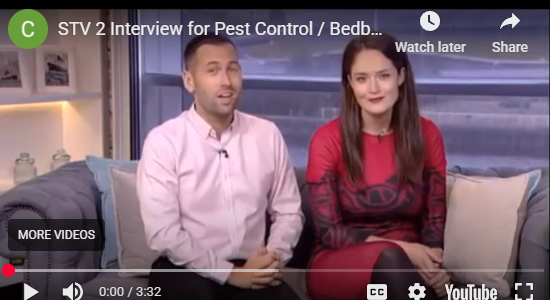
Over the years I’ve been fortunate enough to help many people eradicate their bedbug problems. Aside from being paid to do the work the other reward I’ve found is in being able to help fix their bedbug problem and give them a decent nights sleep. This factor is a vital aspect to look for when looking any bedbug exterminator as they need to have some passion for the job beyond money so that their motivation is as high as possible when dealing with your problem.
Below are a few reviews previous customers were kind enough to leave over the years about our bedbug treatment service on google.


Some more information about bed bugs Do you always break out into rashes or spots when they bite you?
Cimicosis is the name given to the rash or marks made on the skin by bedbug bites. 2/3’s of people respond to bed bug bites with bite marks or rashes on there skin.
If memory serves correctly 1/3 of people do not respond to bedbug bites. In this small number of people bedbug bites cause no rashes or spots to appear on there skin. So they are still being bit by bed bugs but there body is not responding to the bites. Quite often these people can have the worst infestations as they don’t realise they have a problem untill it becomes severe enough to be noticeable.
How do bed bugs tend to live?
They tend to live close to there hosts. In the case of home infestations -or invasions some would call- around our bedroom and living furniture firstly and as an infestation gets worse then they travel further and further infesting other areas.
Bedbugs are known to aggregate in clusters. Various theories are put forward as to why they do this. It could be to make mating easier, protect from being predated by larger arthropods (bugs) or to hold and keep moisture to prevent them from shrivelling up (desiccation).
Bedbugs will not always live in clusters. It has been found in some case that female bedbugs can travel to other sites away from clusters. This can be a potential reason for infestations expanding rapidly in suitable conditions.
Do bedbugs spread disease?
One would think that an insect that pierces its host skin should be able to pass on some form of disease on occasion.
One would be wrong in this assumption. To date no practically relevant disease transmission data has been discovered. There is evidence, however. in one study i remember reading linking arbovirus transmission to bedbugs but no examples in the real world of such transmission. So currently they are not believed to transmit any diseases.
What methods can I use to protect my fabrics from bedbugs?
This is one where most people just gloss over when explaining on how to treat bedbugs. Probably because of conflicting advice by different people and lack of clarity.
The methods include:
Boil washing or tumble drying
Washing or tumble drying at 60 degrees Celsius has been found to completely kill all stages of ana bedbugs from egg to adult.
Freezing
Freezing at minus 18 degrees Celsius has been found to also kill all stages of bedbugs but it takes considerably longer. A period of 2-3 days.
Dry cleaning
The chemicals used in dry cleaning will also kill bedbugs.
Heat treatment
Heat treatment mentioned in the physical treatments above will also completely kill all bedbugs in fabrics and clothing. It is however an expensive method to treat clothing and quite often other methods are more cost effective and suitable.
Pest Control Services
Request A Call Back Form
Members Of:

Why you should use our service:
- We are extremely knowledgeable & experienced in all aspects of pest control
- We use unmarked vehicles.
- We have no hidden charges & offer great value for money.
- We are honest about our work and costs.
- We’re available 7 days a week including evenings.
- We wear a uniform and I.D badge when we come to your address.
- We’re friendly & reliable.
Google Reveiws
Protect Your Home or Business Today
Contact City Pest Solutions for rapid, reliable pest control.
Call Now 0141 846 0022Contact Us